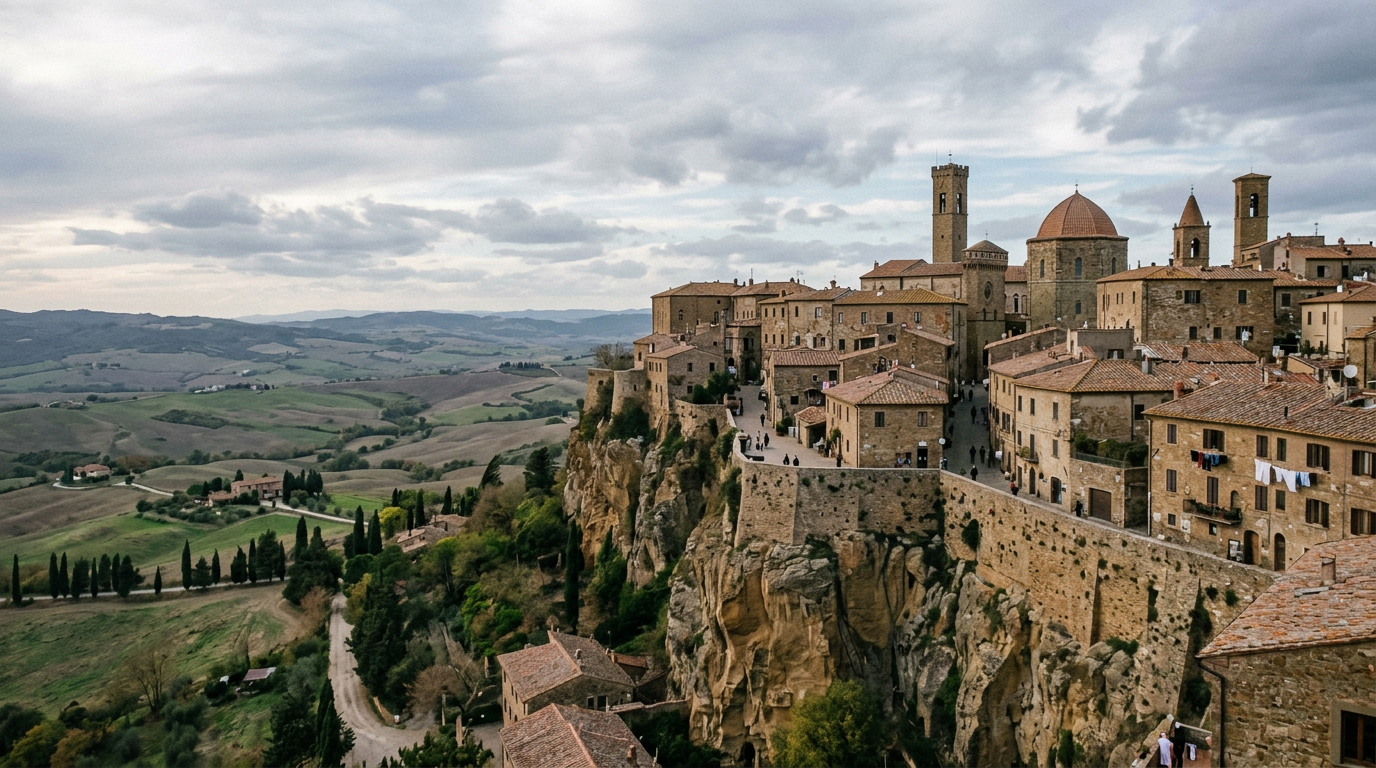
Volterra is built on a clifftop at nearly 550 metres above sea level, battered by wind and surrounded by eroded white clay landscapes - the Balze - which eat away at the city year by year. It is a city that seems not to belong to conventional Tuscany: it has neither the gentle hills of Chianti nor the reddish villages of the Val d’Elsa. It has something rougher, more ancient.
The Etruscans called it Velathri, and here they built one of the most important cities of their civilisation. Three thousand years of history on that clifftop can still be felt.
The Ombra della Sera - the Etruscan bronze statue with its impossibly elongated body - is kept in the Guarnacci Museum in Volterra. It is one of the most extraordinary works of ancient art, in a city that most tourists never visit.
Volterra: 3,000 years of history on a clifftop
Volterra has been inhabited continuously for at least 3,000 years. Before the Etruscans built their powerful walls - still partly visible - there were Iron Age settlements. The Etruscans brought their art, their funerary rites and their sophisticated craftsmanship here. The Romans conquered the city in 260 BC and transformed it into a Roman municipality.
In the Middle Ages, Volterra was a free commune and then a lordship. In the Renaissance, the Medici conquered it and built the Fortezza Medicea - still intact, still used as a maximum-security prison.
What strikes visitors to Volterra is its temporal density: within a few square kilometres you find traces of every era, from the Etruscan walls of the 6th century BC to the medieval palaces of the 13th, from Roman baths to the Renaissance fortress.
The Etruscans at Volterra: the Guarnacci Museum
The Museo Etrusco Guarnacci in Volterra is one of the most important Etruscan museums in Italy. Founded in 1761, it is one of the oldest civic museums in Europe, housing more than 600 Etruscan cinerary urns, tools, jewellery and bronzes.
The collection of cinerary urns is exceptional for both quantity and quality. Volterra’s Etruscan urns have a distinctive character: the lid depicts the deceased reclining, often with an absorbed or melancholy expression. The reliefs on the sides show mythological scenes.
Two pieces not to be missed:
The Ombra della Sera (Evening Shadow): an Etruscan bronze statue of a young man with impossibly elongated proportions - a reed-like, almost surreal body. It has astonished artists and critics throughout the ages; Giacometti, when he saw it, was speechless.
The Urna degli Sposi (Urn of the Spouses): a 1st-century BC terracotta masterpiece depicting an elderly couple reclining together, with an expression of serenity and mutual affection. It is one of the most moving representations of conjugal love that ancient art has left us.
The Balze: the erosion that swallowed the city
To the north of Volterra, towards the Era valley, the clay soil has eroded over centuries to create the Balze - escarpments of white and grey clay that crumble continuously downward.
The phenomenon is not merely scenic: it has swallowed parts of the city. Medieval churches, Roman buildings and sections of the Etruscan necropolis have fallen into the Balze over the centuries. The Camaldolese monastery of Badia, founded in the 10th century, still stands on the edge of the Balze, dangerously close to the drop.
They can be reached on foot from Volterra in about 15-20 minutes. The landscape of white clay, with fragments of walls emerging from the erosion, is one of the most unusual in Tuscany.
Alabaster: Volterra’s traditional craft
Volterra alabaster is a fine-grained, translucent stone ranging in colour from white to grey. It has been worked by craftsmen for centuries to produce statues, lamps and decorative objects.
The workshops of alabaster craftsmen are found throughout Volterra’s historic centre. Some are open to the public and allow visitors to observe the working process: the raw stone, roughing out, finishing, polishing.
The Museo dell’Alabastro (Alabaster Museum), in the historic centre, tells the story of this craft from its Etruscan origins to the present day.
The Roman Theatre: spectacular and little known
The Roman Theatre of Volterra is one of the best-preserved Roman theatres in Tuscany - and also one of the least known. It lies just outside the medieval walls, on the northern side of the city, and can be seen from above along the road that follows the walls.
Built in the 1st century BC, it had a capacity of around 2,000 spectators. The tiered seating, the stage foundations and several columns remain. Its position, overlooking the hills, is evocative.
Entry is paid, with hours varying by season.
How to arrive from Poggibonsi
Volterra is about 35 kilometres from Poggibonsi. The most convenient route is along the SS68 heading west:
- From Poggibonsi, follow the SS68 towards Colle Val d’Elsa and then towards Volterra
- The road climbs through scenic routes with fine views over the Val d’Elsa and the Valdicecina
Journey time is about 40-45 minutes. Parking is outside the historic centre’s walls.
There is no convenient public transport to Volterra from nearby towns - a car is essentially required.
Planning a trip to Tuscany?
Hotel Alcide is in Poggibonsi, in the heart of the Val d’Elsa.
25 km from Siena, 12 from San Gimignano, in the heart of Chianti.
The Ancillotti family has welcomed guests here since 1849.