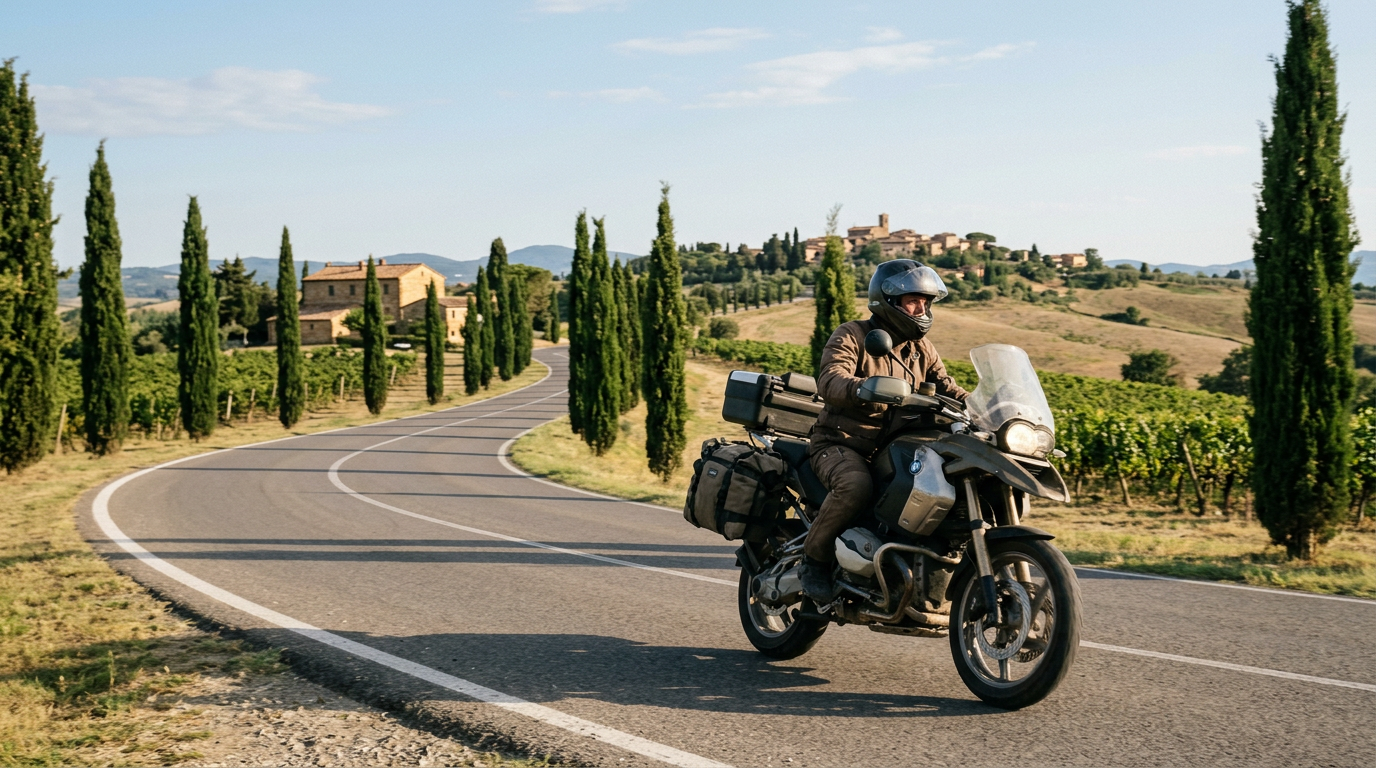
Tuscany by motorcycle has something a car cannot give: the wind, the scent of the forest, the curve that opens onto an unexpected view. Tuscan roads - winding, panoramic, often deserted - seem designed for the pleasure of two-wheel riding.
Switch off the engine at a viewpoint in the Val d’Orcia, remove the helmet, stand still for five minutes. No glass, no windscreen: just the silence and the landscape. The motorcycle is the only way to experience Tuscany in a completely immersive way.
Why Tuscany is perfect for motorcycles
Tuscany has ideal characteristics for motorcycle tourism:
The roads: the network of provincial and secondary roads in Chianti, the Val d’Orcia and the Maremma is dense with curves, elevation changes and scenic views. No motorways are obligatory - you can do everything on state and provincial roads.
The distances: the main villages are 20-40 km apart from one another. Perfect for short stretches with frequent stops.
The traffic: outside city centres and outside high season, Tuscan roads are relatively quiet. The many groups of motorcyclists who ride them is an indicator of their appeal.
The context: stopping at the roadside to photograph the towers of San Gimignano or Castello di Brolio is a pleasure a car cannot give.
The Chianti roads: curves and views
The SS222, the “Strada Chiantigiana”, is the most famous road in Chianti. From Florence it descends towards Siena through Greve, Panzano, Radda, Castellina: 80 km of scenic curves through vineyards and olive groves.
But the most beautiful Chianti roads are often secondary ones:
- The SR222 from San Donato in Poggio towards Radda: steep climbs with sudden openings over the landscape
- From Castellina towards Gaiole via Lecchi: white gravel roads alternating with tarmac, low traffic
- From Panzano towards Montefioralle: 2 km of climb on a narrow road, with the medieval village at the end
For motorcycles, the Chianti white gravel roads (unpaved) are passable with “enduro” or trail tyres, not with sports bikes on road tyres. It is worth checking the road surface before turning onto one.
The Via Cassia between Siena and Rome
The SS2 Via Cassia is the Roman road connecting Rome to Florence. The stretch between Siena and Montalcino crosses the heart of the Sienese crete - a landscape of white clay, infinite undulations, isolated cypresses.
It is a wide road, relatively flowing, with moderate traffic out of season. It does not have the curves of Chianti, but it has scenery of rare beauty, especially at dawn and sunset.
Stops along the Via Cassia: San Quirico d’Orcia (for Bagno Vignoni and the Val d’Orcia), Buonconvento, Torrenieri (for Montalcino).
The Val d’Orcia road: the UNESCO route
The SP53 and secondary roads of the Val d’Orcia - the ones you see in photographs with cypresses in rows - are even more immersive by motorcycle than by car.
From San Quirico d’Orcia to Pienza (12 km), through white gravel hill roads: the landscape opens in every direction, the cypresses form geometric compositions, the silence is total except for the engine.
The advice: switch off the engine at a viewpoint, remove the helmet, stand still for five minutes. The Val d’Orcia deserves that silence.
The Maremma roads: wild Tuscany
The Maremma, the southern part of Tuscany, has very different roads from Chianti: more open, with long straights between cultivated fields, and then suddenly tufa canyons, villages clinging to cliffs, stretches of Mediterranean scrub.
The route from Manciano (towards Saturnia) to Pitigliano, then to Sorano and Sovana, is one of the finest motorcycle itineraries in southern Tuscany. Narrow roads, tufa villages, views over the Maremma countryside.
Saturnia is an almost obligatory stop - the free natural thermal baths after a morning on the road are an experience hard to forget.
Hotel Alcide: motorcycle parking and starting point
Hotel Alcide in Poggibonsi has motorcycle parking. The property is an ideal starting point for the itineraries described: 15 minutes from Chianti, 30 minutes from Siena, 1h30 from the Maremma.
The Ancillotti family, since 1849, has welcomed travellers of all kinds, including motorcyclists who use Poggibonsi as a base for exploring the region.
Practical tips for motorcycle tourists
Clothing: Tuscan weather can vary significantly. Spring and autumn require layered clothing - mornings are cool, afternoons warm. In summer, the heat is intense in the central hours.
Fuel: petrol stations are fairly frequent on the main roads. On more secondary roads (white gravel roads, rural areas), they can be absent for tens of kilometres.
Parking in villages: motorcycles can park in many areas where cars cannot. However, historic centres with ZTL apply to motorcycles too.
Season: spring and autumn are ideal. Summer is beautiful but hot; winter is doable on fine days, but rain and cold make it less pleasant.
Planning a trip to Tuscany?
Hotel Alcide is in Poggibonsi, in the heart of the Val d’Elsa.
25 km from Siena, 12 from San Gimignano, in the heart of Chianti.
The Ancillotti family has welcomed guests here since 1849.