When Dante Alighieri wrote the verses describing the giants of Hell in the Divine Comedy, he used the towers of Monteriggioni rising above its circular walls as his reference image. “Com’ha Montereggion di torri coronato” - as Monteriggioni is crowned with towers. It was the 13th century, and already then the walls of Monteriggioni were famous enough to serve as a metaphor in an epic poem.
“Com’ha Montereggion di torri coronato” - Dante Alighieri, Inferno, Canto XXXI. In the 13th century the walls of Monteriggioni were already famous enough to become a metaphor in the most important literary work in the Italian language.
Monteriggioni: 14 towers and medieval perfection
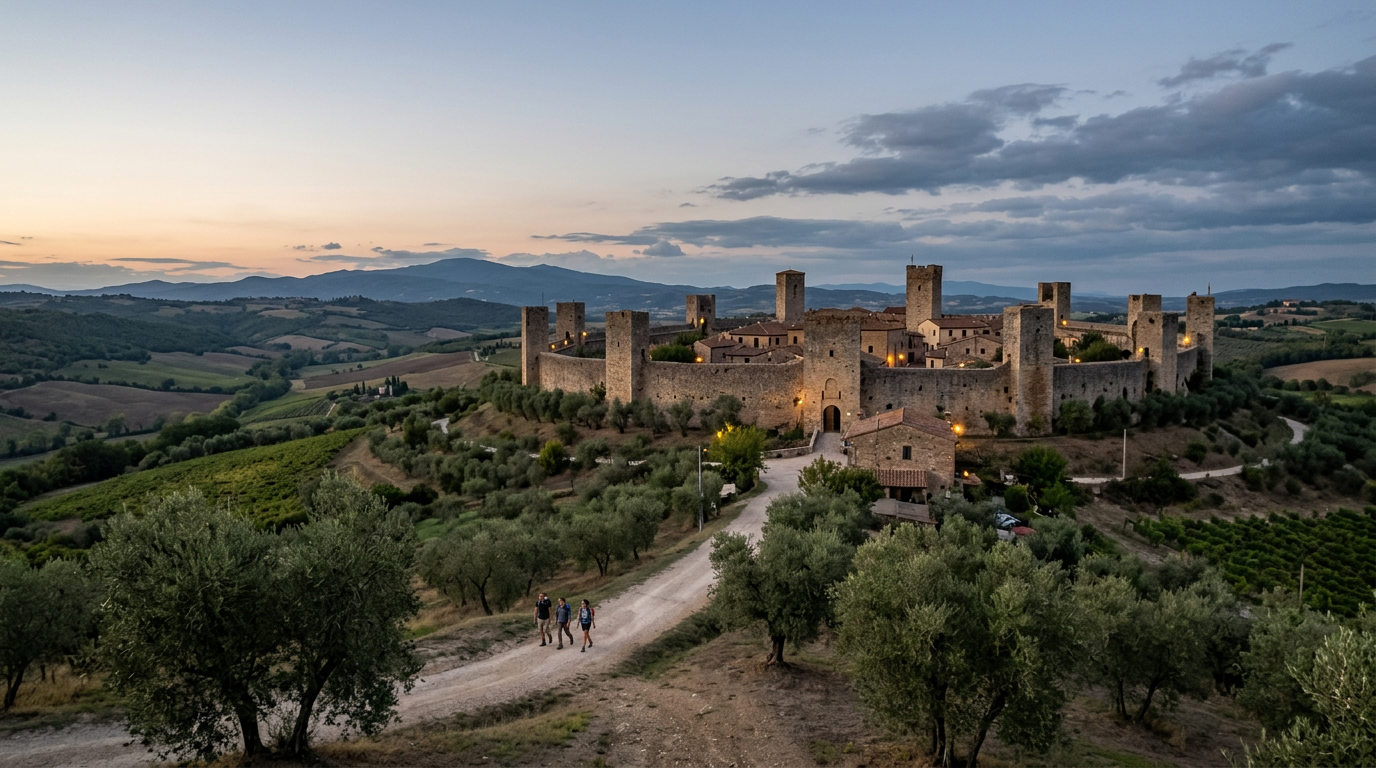
Monteriggioni is perhaps the most photographed medieval village in Tuscany - not the largest, not the richest in museums, but the most visually complete. The circular walls with their 14 square towers, built by the Sienese between 1213 and 1219 as a military outpost against Florence, are still intact.
The perfection of the village lies in its scale: the ring of walls is small - about 560 metres in perimeter - and contains a square, a church, a few houses, a few restaurants. There is nothing too much, nothing in excess. It is as if time froze at the moment the town was just completed.
Seen from outside, from the motorway or the provincial road, the profile of the village - the ring of walls crowned with towers - is one of the most recognisable views in Tuscany. Seen from inside, it is surprisingly intimate.
Dante and Monteriggioni: the quotation in the Inferno
Canto XXXI of the Inferno describes Dante approaching the pit where the giants are submerged, comparing them to the towers of Monteriggioni rising above the low wall:
“Però che, come su la cerchia tonda / Montereggion di torri si corona”
The quotation dates from around 1307-1308, almost contemporary with the construction of the walls, and testifies to how famous the village was in its own time. Dante evidently knew Monteriggioni, or had heard of it, and used it as a certain reference point for his readers.
Today the quotation is inscribed on a plaque at the entrance of the village, and Dante’s name is woven into the history of the place.
The walls: how they were built in the Middle Ages
The walls of Monteriggioni are an excellent example of Sienese medieval military architecture. Built in local stone - limestone and sandstone - they are about 2 metres thick at the base and 7-8 metres high. The 14 square towers rise a further 5-6 metres above the walkway.
Today you can climb the walls and walk the rampart walkway for a stretch - about 270 metres out of 560 total are open to the public. The view from above over the surrounding countryside, with vineyards, olive groves and hills, is remarkable.
The ticket to climb the walls also includes access to a permanent exhibition on the history of the fortress.
What is inside the walls: the small square and the church
Inside the walls, Monteriggioni is even smaller than it looks from outside. The main square, Piazza Roma, is surrounded by a few houses, a few restaurants, the tourist office and the church.
The Church of Santa Maria Assunta is the only building of note inside the walls. It has a simple Romanesque façade and a sober interior with some medieval artworks. It is not a masterpiece, but it is authentic and well-preserved.
The restaurants of Monteriggioni are generally touristy and prices are high. Those who want to eat well at more reasonable prices prefer to move to the surrounding villages.
When to visit: out of season it is a different place
Monteriggioni is crowded with tourists in summer, especially on weekends. The small square becomes almost unbearable with the masses. During these periods, the experience reduces to taking a photo in front of the walls and leaving.
Out of season - November, December, January, February - the village rediscovers its authentic dimension. You walk the walls almost alone, the square is quiet, the few open restaurants have normal prices. It is a completely different place.
Even early in the morning during the season - before 9am - you can experience Monteriggioni before the tourist coaches arrive.
How to get there from Poggibonsi: 20 minutes
Monteriggioni is about 20 kilometres from Poggibonsi, reachable in 20-25 minutes by car along the SS2 Via Cassia towards Siena. The village is visible from the A1 motorway (Siena Nord exit), from which it is about 3 kilometres.
Parking is outside the walls, free or paid depending on the season.
The July medieval festival: Monteriggioni di Torri si Corona
Every year in July, Monteriggioni hosts “Monteriggioni di Torri si Corona”, a medieval festival that fills the village with costumed performers, weapon shows, musicians and medieval artisans.
It is one of the most evocative events of the Tuscan summer. The walls lit up at night, the medieval costumes, the torches: the festival transforms the village into something that approaches how it must have looked in the 13th century.
From Hotel Alcide in Poggibonsi, Monteriggioni is 20 minutes by car - perfect for an evening outing.
Planning a trip to Tuscany?
Hotel Alcide is in Poggibonsi, in the heart of the Val d’Elsa.
25 km from Siena, 12 from San Gimignano, in the heart of Chianti.
The Ancillotti family has welcomed guests here since 1849.