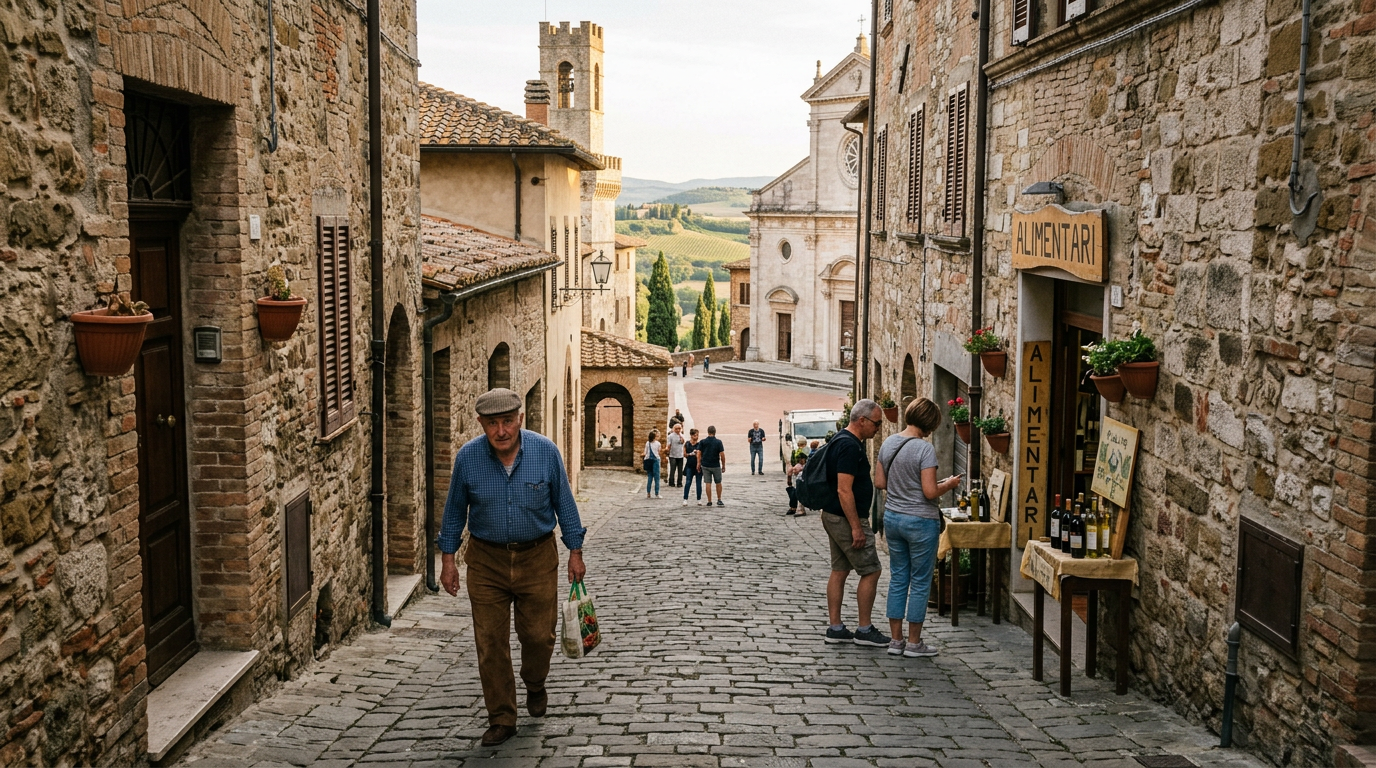
Tuscany has more well-preserved medieval villages than any other region in Italy. They are not museum pieces, many are still lived-in communities with shops, schools, bars and the rhythms of daily life. Visiting them gives access to a way of inhabiting landscape and architecture that has been maintained, with modifications, for seven centuries.
Tuscany’s medieval villages are not open-air museums - they are lived-in places. The bar on the corner, the school up the street, the old woman at the window: that’s what makes them different from every other medieval village in Europe.
Why Tuscany has the best medieval villages in the world
The preservation is not accidental. Several factors contributed:
Geography: the hilltop position of most Tuscan villages made them unsuitable for industrial-era development. Railways and roads were built in the valleys; the hills were left to continue much as they were.
Relative stability: after the Medici consolidation of power in the 16th century, Tuscany avoided the large-scale conflicts and destructions that reshaped many other Italian regions.
Stone quality: the local stone, sandstone, limestone, travertine, weathers slowly and maintains its colour. Medieval buildings in Tuscany look roughly similar to how they looked five centuries ago.
Economic value: by the 20th century, the aesthetic and cultural value of these villages became economically important enough to maintain them.
San Gimignano: the Manhattan of the Middle Ages
San Gimignano is the most visited medieval village in Tuscany, and the most immediately dramatic. Fourteen towers rise above the hilltop, visible from a considerable distance across the valley.
In the medieval period, noble families competed by building progressively taller towers, height signalled wealth and power. The city once had over 70. The 14 remaining reach up to 54 metres.
UNESCO listed San Gimignano in 1990. The Collegiata church contains some of the finest medieval frescoes in Tuscany, cycles of Old and New Testament scenes by 14th and 15th-century Sienese painters. Ghirlandaio’s Chapel of Santa Fina, in the right nave, is particularly beautiful.
The Torre Grossa (the tallest surviving tower) can be climbed for panoramic views. Dondoli’s gelateria on Piazza della Cisterna has won multiple world championship titles and is, in the best possible way, absurd to find in a 13th-century village.
Go early: by 10am the tour buses start arriving. Before 9am it belongs to you.
12 km from Hotel Alcide in Poggibonsi.
Monteriggioni: the perfect walled town
Monteriggioni is the most visually complete of all Tuscany’s medieval villages, a perfect circle of walls with 14 square towers, containing a tiny village of a few dozen houses, a church and a small piazza.
Dante mentioned it in the Inferno (Canto XXXI) as a comparison for the giants he was describing: “as Monteriggioni is crowned with towers.” The comparison would have been immediately recognisable to his medieval readers.
The walls can be walked, about 270 metres of the 560-metre perimeter is accessible to visitors. The view from the battlements, looking out over the Chianti hills, is excellent.
Inside the walls, there is very little, a small church, a handful of restaurants, a souvenir shop. The village takes 20 minutes to walk completely. But the completeness of its medieval form, the sense of a moment frozen, makes it worth every minute.
20 km from Poggibonsi. Best in the early morning or out of season, in high summer it becomes crowded.
Volterra: the Etruscan city on the cliff
Volterra is different from the other villages on this list: older (the Etruscans built it, over 2,500 years ago), more urban in character, and sitting on a dramatically eroded rocky promontory at 550 metres above sea level.
The Etruscan Guarnacci Museum is one of Italy’s most important collections of Etruscan art, with over 600 funerary urns and bronzes including the extraordinary “Shadow of the Evening”, a slender bronze figure with elongated proportions that startled Giacometti when he saw it.
The Roman Theatre, partially excavated outside the medieval walls, is one of the best-preserved in Tuscany. The “Balze”, eroding clay cliffs that have consumed medieval buildings over centuries, are a geological spectacle unique in the region.
Volterra is also the centre of alabaster carving in Tuscany: workshops across the town still produce objects in the translucent local stone.
35 km from Poggibonsi.
Certaldo: Boccaccio’s home town
Certaldo Alta is a red-brick medieval village built on a hill, connected to the modern town below by funicular or road. It was the birthplace of Giovanni Boccaccio (1313-1375), author of the Decameron.
The village is small, you can walk it in 45 minutes, but dense with character. The Palazzo Pretorio, with coats of arms covering the facade, contains Gothic and Renaissance frescoes. The Casa del Boccaccio is a house-museum with manuscripts and documentation of the author’s life.
The brick colour, a warm, uniform terracotta red, distinguishes Certaldo from the grey stone of most Chianti villages and from the sandstone of Volterra.
In July, Certaldo hosts the Mercantia, an international street theatre festival that fills the medieval village with performers for five nights. One of the most authentic summer events in Tuscany.
15 km from Poggibonsi.
How to see multiple villages in one day from Poggibonsi
The compact geography of the Val d’Elsa makes multi-village days practical:
Option 1 (north): San Gimignano (morning) + Colle Val d’Elsa (afternoon) + Certaldo (late afternoon). All within 15 km of Poggibonsi.
Option 2 (south): Monteriggioni (morning) + Siena (afternoon). Combined, these cover the medieval landscape from the Chianti to the Sienese plain.
The key is to arrive at each village early, before the crowds, and to leave when it starts filling up. Two hours per village is usually enough for the essentials.
Planning a trip to Tuscany?
Hotel Alcide is in Poggibonsi, in the heart of the Val d’Elsa.
25 km from Siena, 12 from San Gimignano, in the heart of Chianti.
The Ancillotti family has welcomed guests here since 1849.