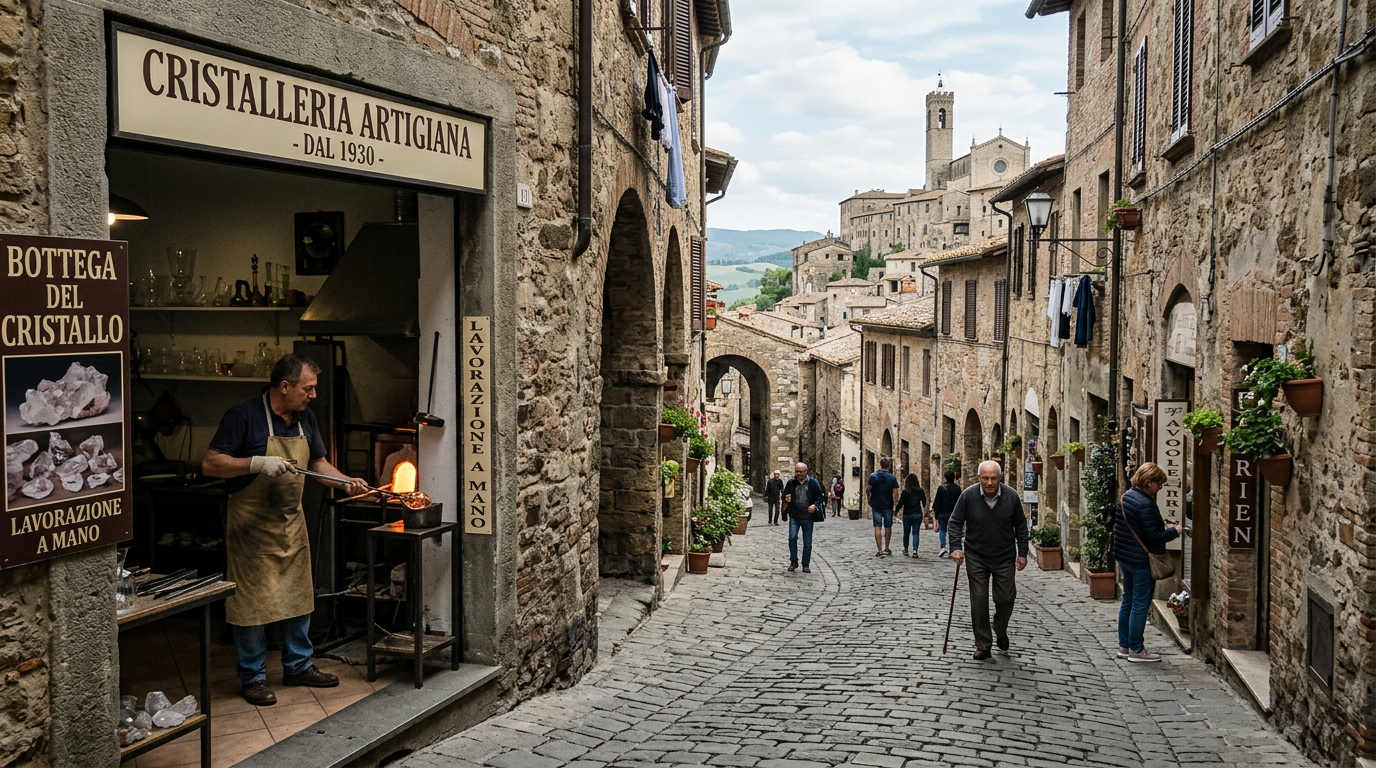
Colle Val d’Elsa is one of those places that Tuscans know well and foreign tourists almost never visit. Just 8 kilometres from Poggibonsi, reachable in 10 minutes by car, it is one of the most beautiful surprises of the Val d’Elsa: a medieval village in red brick clinging to a rocky spur, with a singular industrial history that has made it the world capital of crystal.
Colle Val d’Elsa: upper and lower, medieval and modern
The town has two distinct natures that you sense physically as soon as you arrive. Colle Bassa is the modern part, in the valley: shops, supermarkets, housing, the daily life of a mid-sized Tuscan town. Colle Alta is the medieval village on the spur, connected to the lower part by a steep road.
The contrast between the two sides is sharp and fascinating. Below, people live in the present; above, you walk in the 14th century.
Colle Val d’Elsa produces 15% of the world’s crystal. But it is also the city where Arnolfo di Cambio was born - the architect of Florence’s Duomo. Two forms of excellence that most foreign tourists have never heard of.
Colle Alta is relatively small - you can walk it all in an hour - but every metre is dense with history. The streets are still called Via del Castello, Via Gracco del Secco, Vicolo dell’Arco. Medieval and Renaissance palaces succeed one another without interruption.
The crystal of Colle: a centuries-old tradition
Colle Val d’Elsa produces 15% of the world’s crystal. This is not a trivial statistic: it means that almost one in six glasses, vases or crystal objects sold worldwide was produced here.
The tradition has distant roots. As early as the 14th century, Colle had glassworks. The industrial turning point came in the 19th and 20th centuries, when glassworks multiplied, exploiting the hydraulic power of the Elsa river and then electric energy. Today the large factories are on the plains, in the industrial areas of Colle Bassa, but the connection to crystal remains a strong part of local identity.
Crystal and artistic glass shops can be found both in Colle Alta and along the main road in Colle Bassa. Prices vary enormously: from industrially produced objects to high-quality handcrafted pieces.
The historic centre of Colle Alta: what not to miss
The medieval village of Colle Alta is essentially walkable along a single main street - Via Gracco del Secco and its continuation Via del Castello - with side alleys opening on both sides.
Porta Nova: the medieval gate that introduces the village from the eastern side. It is the most evocative entry point, with the view over the valley opening behind you.
Palazzo Campana: the building that “crosses” the main street, creating an arch that divides the village in two. It is a 16th-century noble palace creating one of the most characteristic views in the village.
The Castle and the Torre Grossa: the oldest part of Colle Alta, at the highest point of the spur. Here stood the original medieval castrum. Some towers and sections of walls remain.
The Cathedral of Santa Maria in Canonica: rebuilt in the 17th century in Baroque forms, it preserves some medieval artworks and a bronze crucifix attributed to Giovanni di Balduccio.
The birthplace of Arnolfo di Cambio
One of the most surprising discoveries in Colle Val d’Elsa is that Arnolfo di Cambio - the architect who designed Florence’s Duomo, Palazzo Vecchio and the Basilica of Santa Croce - was a native of Colle. He was born here around 1240.
Via Arnolfo di Cambio, a narrow lane in the historic centre, is identified as the site of his childhood home. There is a commemorative plaque. It is one of those details that makes you reflect on the extraordinary density of talent that medieval Tuscany produced.
The Crystal Museum: history of an excellence
The Crystal Museum of Colle Val d’Elsa tells the history of local glassmaking, from medieval craftsmanship to modern industry. It is housed in a restored former smelting furnace - a choice that adds authenticity to the experience.
The collection includes crystal pieces from various periods, production tools and documentary films about the craft. It is not a grand museum, but it is carefully curated and tells an authentic industrial story.
How to get there from Poggibonsi: 8 km
Colle Val d’Elsa is 8 kilometres from Poggibonsi, reachable in 10 minutes by car along the SS68. Parking is available at the foot of Colle Alta; from there you walk up or take a shuttle.
There are also local buses connecting Poggibonsi and Colle Val d’Elsa.
Combining Colle Val d’Elsa with San Gimignano in a day
The position of Colle Val d’Elsa, halfway between Poggibonsi and San Gimignano, makes it perfect to combine with a visit to the medieval towers on the same day. The itinerary could be:
- Morning: Colle Alta, with a visit to the historic centre and the Crystal Museum
- Lunch: in Colle Val d’Elsa or San Gimignano
- Afternoon: San Gimignano (12 km from Colle, 15 minutes by car)
In this way you see two characteristically different villages - one famous, one lesser known - in a single day with no major transfers.
Planning a trip to Tuscany?
Hotel Alcide is in Poggibonsi, in the heart of the Val d’Elsa.
25 km from Siena, 12 from San Gimignano, in the heart of Chianti.
The Ancillotti family has welcomed guests here since 1849.