The Chianti wine region is one of the most visited parts of Tuscany, and rightly so. But many visitors drive through it without really stopping, missing the wineries, the smaller villages and the qualities that make this landscape so distinctive.
The “Black Rooster” on the bottle neck is not just a label - it’s the mark of a specific territory, specific soil, specific altitude. Understanding what Chianti Classico actually means changes the way you taste it.
The Chianti Classico region: boundaries and character
The Chianti Classico DOCG zone covers approximately 720 square kilometres between Florence and Siena. It’s defined by specific geographical boundaries, the “Black Rooster” (Gallo Nero) symbol on the bottle neck identifies wines from within this zone.
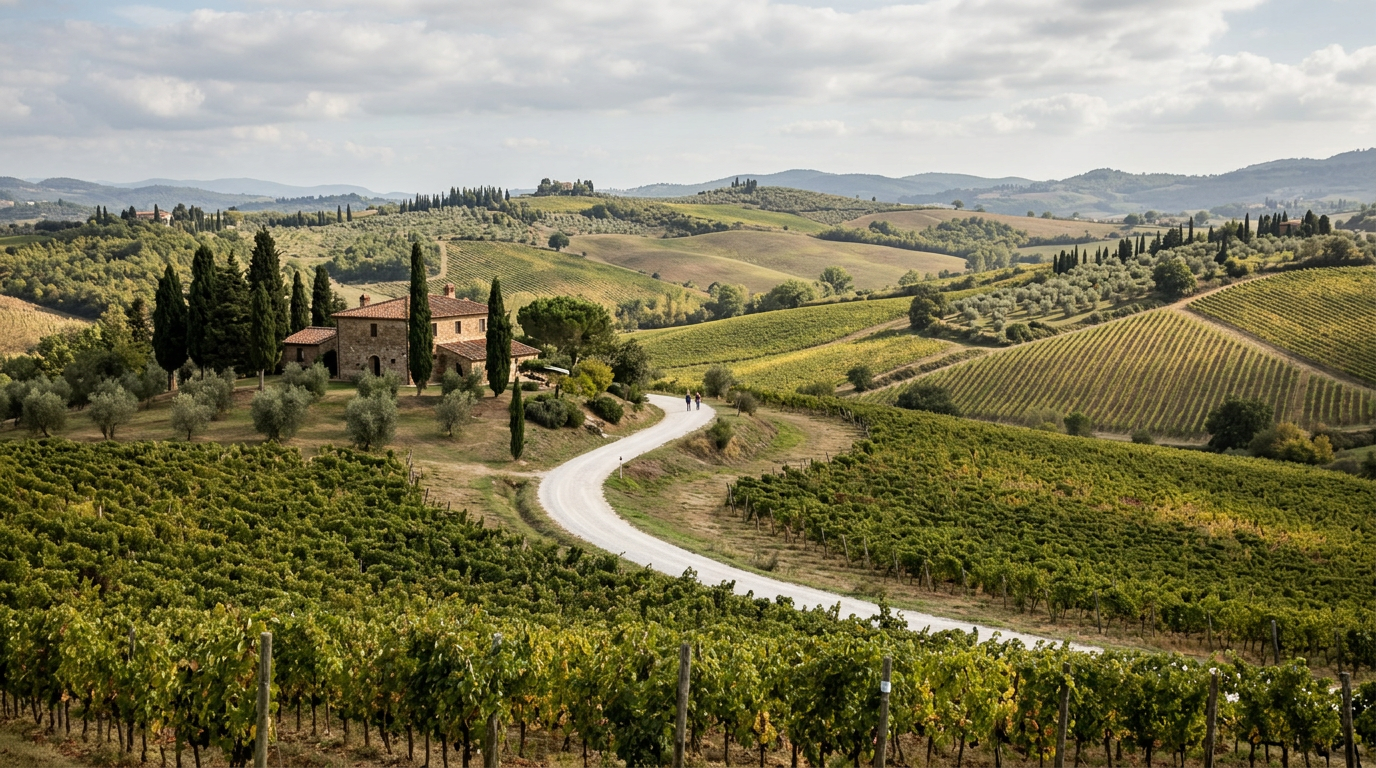
The landscape is one of the most recognisable in Italy: rolling hills covered in vineyards and olive groves, punctuated by cypress trees, hilltop villages and occasional castles. The elevation ranges from 250 to 600 metres above sea level, which gives the region its distinctive climate, warm summers that fully ripen the Sangiovese grape, and cool nights that preserve acidity.
Sangiovese is the sole permitted grape for Chianti Classico. Unlike other Italian regions that blend multiple varieties, Chianti Classico’s identity rests on a single grape, and the enormous range of styles that grape can express across different soils, altitudes and producers.
From Poggibonsi, you enter the southern edge of the Chianti Classico zone in about 15 minutes driving east. Hotel Alcide, at this same location since 1849, is literally at the gateway.
The Gallo Nero villages: Greve, Panzano, Radda, Gaiole
Each of the main Chianti villages has a distinct character:
Greve in Chianti (30 km from Poggibonsi): the de facto capital of the Chianti Classico. The asymmetric loggia-fronted Piazza Matteotti is one of the most characterful squares in the region. The Enoteca Falorni offers tastings of dozens of Chianti producers.
Panzano in Chianti (5 km north of Greve): famous for its position overlooking the “Conca d’Oro” valley, and for Dario Cecchini, a butcher who has become one of Italy’s most celebrated food personalities, quoting Dante while cutting meat and serving wine to customers.
Radda in Chianti: the most architecturally intact of the main Chianti villages. Medieval walls, the Palazzo del Podestà, quiet streets, and some of the best producers in the zone in the surrounding hills.
Gaiole in Chianti: the eastern gateway to the Chianti, and the access point for the Castello di Brolio, the ancestral home of the Ricasoli family, who invented the modern Chianti blend in the 19th century.
How to visit a Chianti winery: what to expect
A typical winery visit in the Chianti Classico includes a tour of the cellar (barrel room, bottling line) and a tasting of three to five wines. Most require advance booking, at least three to five days ahead, more in high season.
The tasting structure varies by producer:
- Small family estates: often led by the owner or winemaker, very personal
- Mid-size producers: guided by a professional wine communicator, more structured
- Large commercial estates: tours with fixed times, larger groups, less personal
The cost of a standard tasting ranges from €15 to €40 per person. Premium experiences with multiple reserve wines and food pairings can reach €60-100.
The three quality levels of Chianti Classico:
- Annata: the base wine, minimum 12 months ageing
- Riserva: minimum 24 months ageing, more complexity
- Gran Selezione: minimum 30 months, from a specific vineyard selection, the most individual expression
The Chianti road trip: a self-drive itinerary
The most rewarding way to explore the Chianti is by car on the secondary roads, including the famous “strade bianche” (white gravel roads).
Starting from Poggibonsi:
- Drive east to Castellina in Chianti (15 km), walk the covered medieval Via delle Volte
- Continue to Radda in Chianti (20 km further), intact medieval walls, good local wine shops
- Down to Gaiole (10 km) and Castello di Brolio (7 km south of Gaiole), cellar tour
- North to Panzano in Chianti, the butcher, the panorama
- Greve in Chianti, the wine enoteca, the piazza with its characteristic loggias
- Return to Poggibonsi via the SS222 south (30 km)
Total distance: approximately 120 km. Allow a full day, or split across two days.
Chianti and food: the best pairings
Chianti Classico is a wine built for food. The combination of bright acidity and firm tannins makes it the natural partner for the fatty, protein-rich dishes of Tuscan cooking.
Classic pairings:
- Bistecca alla fiorentina (thick-cut Chianina steak): Chianti Classico Riserva
- Pappardelle al cinghiale (broad pasta with wild boar ragù): Chianti Classico Annata
- Pecorino stagionato (aged sheep’s cheese): any Chianti Classico
- Ribollita (Tuscan bread and vegetable soup): young Chianti Classico
Hotel Alcide: at the gateway to the Chianti
Poggibonsi sits at the western boundary of the Chianti Classico zone. Hotel Alcide’s central position makes the wine country immediately accessible, and provides a comfortable base to return to after a day in the vineyards, without the complications of driving on narrow Chianti roads after a full day’s tasting.
Planning a trip to Tuscany?
Hotel Alcide is in Poggibonsi, in the heart of the Val d’Elsa.
25 km from Siena, 12 from San Gimignano, in the heart of Chianti.
The Ancillotti family has welcomed guests here since 1849.