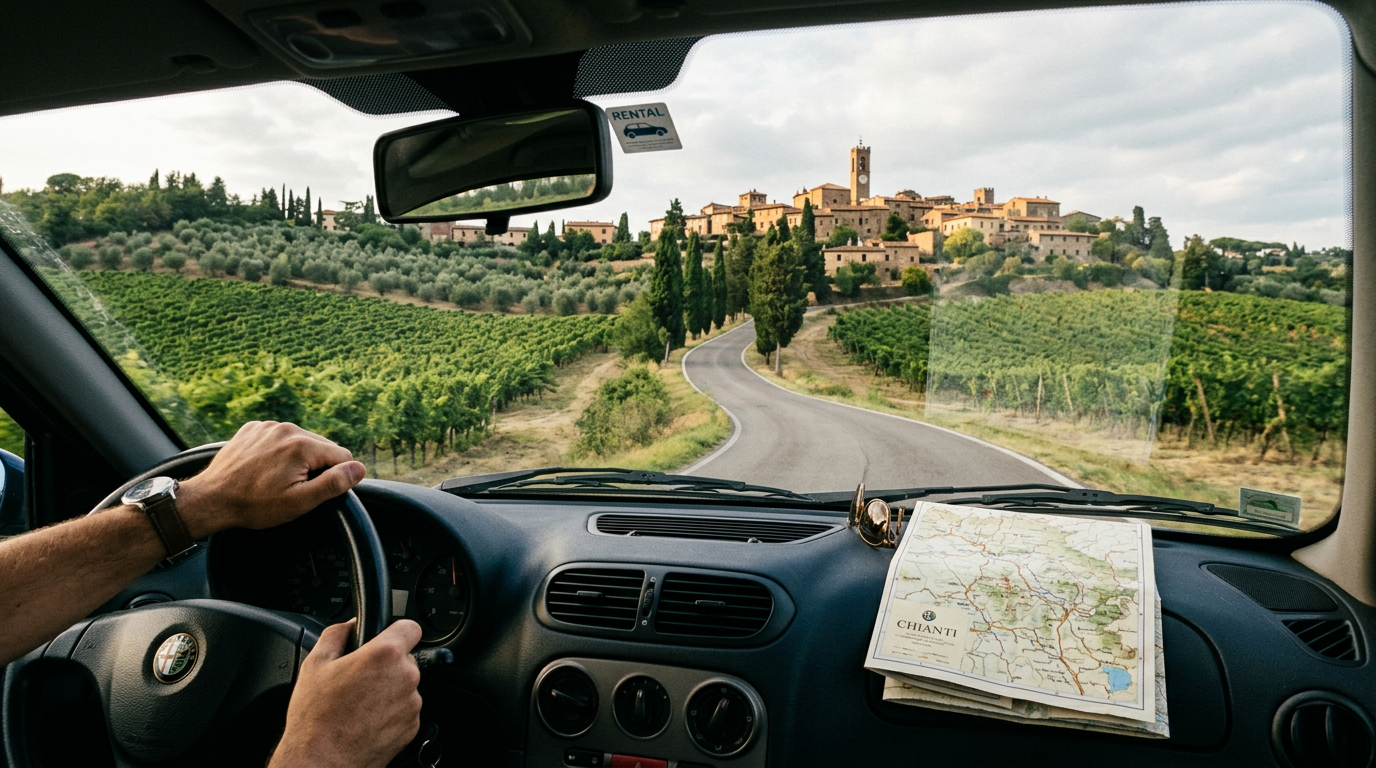
Chianti is best explored by car. Not because there are no paths or white gravel roads for those who prefer cycling - there are - but because the distances between villages, wineries and viewpoints are conceived on an automotive scale. One hour of driving in Chianti is worth a whole afternoon.
This itinerary starts from Poggibonsi and crosses the heart of the Chianti Classico: Castellina, Radda, Gaiole, Panzano, Greve. It can be done in a day, but two days is better.
Chianti by car: the freedom to stop whenever you want
The SS222 is the main axis, but the secondary roads - many unpaved, called “strade bianche” - are often more beautiful. From one winery to the next, from one Romanesque parish church to the next, Chianti unfolds in hundreds of possible routes.
The advantage of the car is total freedom: you stop in front of a gate with a “direct sale” sign, knock, discover a small family winery. Or you spot a Romanesque parish church from above in the middle of olive groves and decide to go down.
There is no wrong way to do Chianti by car. There is only the rushed way.
The advantage of the car is total freedom: you stop in front of a gate with a “direct sale” sign, knock, discover a small family winery. Or you see a Romanesque parish church from above among olive groves and go down. Chianti reveals itself only to those who are not in a hurry.
Departure from Poggibonsi: the gateway to Chianti
From Hotel Alcide in Poggibonsi, head east along the SS429, then turn towards Castellina in Chianti. Alternatively, take the SP102, a secondary road that climbs directly into the hills - a more scenic route.
From Poggibonsi, the landscape changes almost immediately: you leave the Val d’Elsa plain and begin to climb. In 10-15 minutes you are already among the vineyards.
Stop 1: Castellina in Chianti
Castellina is the first Chianti Classico town arriving from Poggibonsi. It is about 15 km from Poggibonsi centre, reachable in 20 minutes.
It is a compact village with partially preserved medieval walls and the characteristic Via delle Volte - a covered alley inside the walls running the entire length of the village, lit by arrow slits.
Castellina has several wine shops and visitable wineries. The Museo Archeologico del Chianti Senese, inside the Castle, tells the Etruscan history of the area with finds from local tombs.
Recommended stop: 1-1.5 hours.
Stop 2: Radda in Chianti
From Castellina to Radda is about 15 km north-east. Radda is one of the best-preserved medieval villages in Chianti: the walls are still intact, the historic centre compact and authentic.
The Palazzo del Podestà, with its coats of arms on the walls, dominates the main square. The wineries around Radda produce some of the most highly regarded Chianti Classico in the zone.
Radda is less frequented than Greve and Castellina, making it more pleasant in high season.
Recommended stop: 1 hour.
Stop 3: Gaiole and Brolio
From Radda to Gaiole, descend south-east, about 10 km. Gaiole is a quiet village, less picturesque than the others but the access point for Castello di Brolio.
Castello di Brolio, seat of the Ricasoli family, is about 7 km from Gaiole heading south. The visit includes the winery, the rose gardens and a tasting. It is one of the most significant places in the Chianti Classico - this is where the Chianti blend was created by Ricasoli in the 19th century.
Recommended stop: 2-3 hours at Brolio, 30 minutes in Gaiole.
Stop 4: Panzano and Macelleria Cecchini
From Gaiole, head north-west to Panzano in Chianti, about 25 km. Panzano is famous for two things: the panorama over the “Conca d’Oro” and Dario Cecchini’s Macelleria Cecchini.
Dario Cecchini is not just a butcher. He is a character who has transformed meat into a cultural ritual - he quotes Dante while working, serves wine to customers in the shop, and has opened restaurants next to the butchery. Anthony Bourdain visited him in 2003 in a famous episode of his TV programme.
The stop at Panzano is almost obligatory.
Recommended stop: 1.5-2 hours.
Stop 5: Greve in Chianti
The final stop is Greve in Chianti, about 5 km from Panzano heading north. Greve is the main town of the Chianti Classico, with the characteristic Piazza Matteotti and its asymmetric arcades.
Here the loop closes with a tasting at Enoteca Falorni or one of the many wine shops in the square. Dinner in Greve or nearby.
From Greve to Poggibonsi the return is about 30 km along the SS222 heading south.
Total time and logistical tips
Total route: about 100-120 km between all stops. Estimated time without stopping: 3 hours. Realistic time with stops: at least 6-8 hours.
The advice is not to try to do everything in one day: either choose the northern route (Greve, Panzano, Radda) or the southern route (Castellina, Gaiole, Brolio), and leave the other for another occasion.
Those who stay overnight in the area can spread the stops over two days and experience Chianti without rushing.
Planning a trip to Tuscany?
Hotel Alcide is in Poggibonsi, in the heart of the Val d’Elsa.
25 km from Siena, 12 from San Gimignano, in the heart of Chianti.
The Ancillotti family has welcomed guests here since 1849.