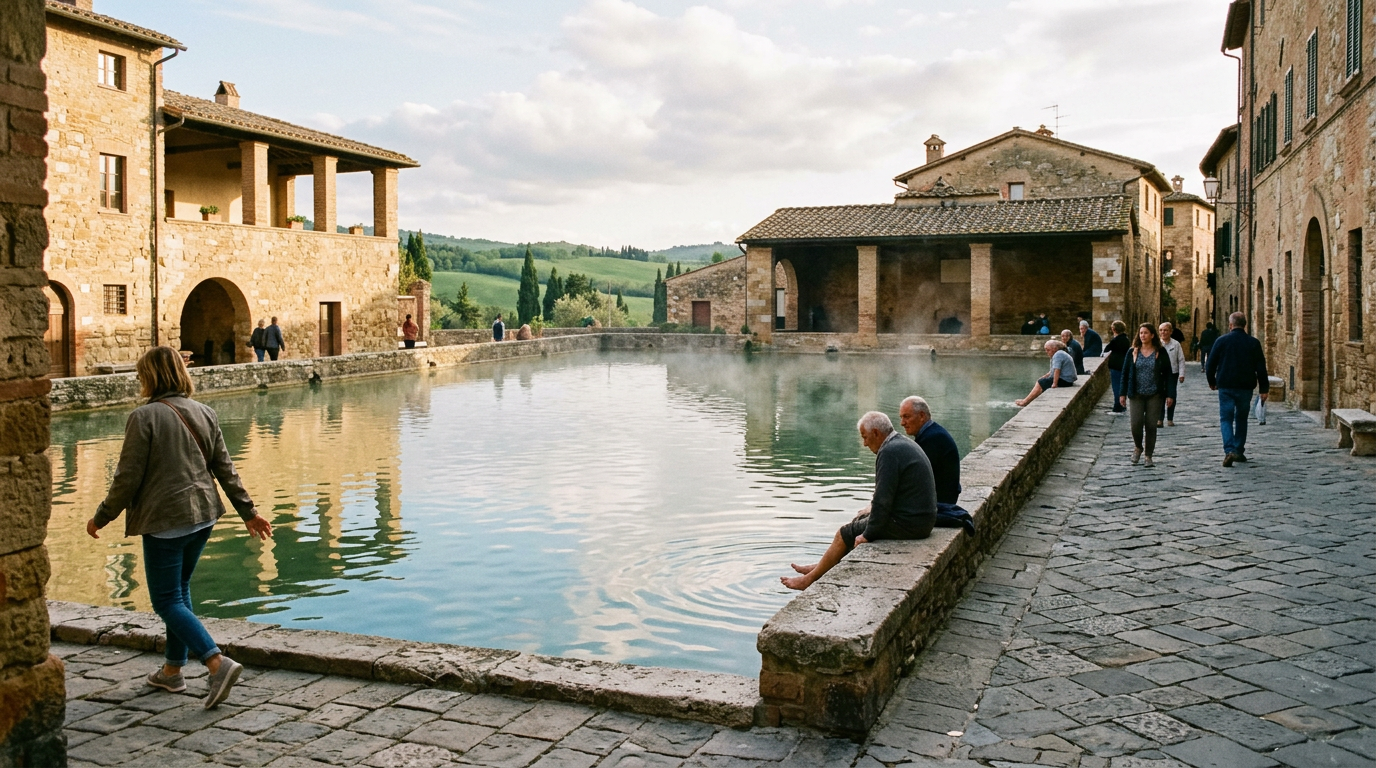
There are places in Tuscany that seem invented by someone with too much imagination. Bagno Vignoni is one of them. A medieval village of a few hundred inhabitants whose main square is not a square in the conventional sense: it is a large rectangular thermal pool, 50 metres long and 20 wide, gently boiling at 52 degrees.
Instead of a fountain, there is steaming water. Instead of café tables, there is vapour rising into the Val d’Orcia sky.
Bagno Vignoni has a square that is not a square: it is a 50-metre thermal pool boiling at 52 degrees, in the heart of the Val d’Orcia. One of the most unique places in Italy.
The pool in the square: Tuscany’s most singular case
The Piazza delle Sorgenti at Bagno Vignoni is, technically, an artificial basin built in the Middle Ages to collect the thermal waters from the spring below. It is fed by a water vein that emerges at about 52 degrees and has a flow rate of almost 30 litres per second.
Today the pool is not swimmable - it is protected by the Soprintendenza - but it is perfectly visible from all sides, you can walk around it, photograph it, observe it. The effect of steam rising on a winter morning is something that stays with you.
What strikes you most is the proportions: the village is tiny, with a handful of streets, a few hotels, a few restaurants. Yet at its centre is this monumental pool that seems to belong to a much larger city. It is an out-of-scale scene, and that is what makes it unforgettable.
History of Bagno Vignoni: from the Romans to Lorenzo the Magnificent
The waters of Bagno Vignoni were already known in Roman times: the Via Cassia, which passes nearby, was built in part to allow the Romans to reach the thermal springs of the area. The medieval village developed slowly around the springs, and in the Middle Ages it became an important stop for pilgrims on the Via Francigena, who appreciated both the healing waters and the opportunity to resupply before continuing towards Rome.
The pool we see today was built during the Middle Ages, but gained definitive importance between the 14th and 15th centuries, when illustrious figures began to visit. Among them, Lorenzo the Magnificent and Saint Catherine of Siena, who came to Bagno Vignoni for thermal treatments - she for arthritis, he for problems with his hands.
The presence of such important figures testifies to how highly regarded the place was in the culture of the time.
Where to bathe in Bagno Vignoni today
Since the main pool is not swimmable, visitors who want to immerse themselves in the thermal waters have several alternatives:
Terme Libere del Gorello: a short distance from the village centre, along the Orcia stream, there are some natural pools formed by thermal water flowing downhill. Access is free; the pools are smaller and less spectacular than the main pool, but the water is thermal and access is unrestricted.
Paid establishments: in the surroundings of Bagno Vignoni there are several establishments offering outdoor thermal pools for a fee. The Acqua Viva, the Parco dei Mulini (with historic pools recovered beneath the old mill wheels) and others offer different experiences, with prices ranging from €15 to €30 per person.
The Parco dei Mulini deserves a special mention: the thermal pools were created within the old medieval mill installations, with hot water flowing through recovered stone structures. It is a place with an authentic character.
The Val d’Orcia around: what to see in a day
The real strength of Bagno Vignoni is its position: in the heart of the Val d’Orcia, a UNESCO heritage site, surrounded by some of the most beautiful medieval villages in Italy.
Within 30-40 minutes’ drive from Bagno Vignoni:
- Pienza (12 km): the Renaissance city of Pope Pius II, with its Duomo, Palazzo Piccolomini and DOP Pecorino
- Montalcino (25 km): the Brunello village, with the medieval Fortress and wineries
- San Quirico d’Orcia (7 km): a small medieval village with the Romanesque Collegiata and the Horti Leonini
- Castiglione d’Orcia (12 km): a less-visited village with a fortress and splendid views over the Val d’Orcia
A well-organised day could include: morning at the thermal baths, lunch at Bagno Vignoni or San Quirico, afternoon at Pienza or Montalcino.
How to get there from Poggibonsi
Bagno Vignoni is about 60 kilometres from Poggibonsi. The most comfortable route is:
- SS2 Via Cassia heading south as far as San Quirico d’Orcia
- From San Quirico, turn towards Bagno Vignoni (about 5 km)
The journey takes about 55-60 minutes, through beautiful scenery: the Sienese crete, the profile of Montalcino, the Val d’Orcia.
There are no convenient public transport connections. A car is practically essential.
Parking at Bagno Vignoni is free, outside the historic centre, and is usually available even in mid-season.
The best time to visit
Bagno Vignoni works year-round, but some times are better than others.
Winter (December-February): the steam on the pools is more intense in cold weather. The village is almost empty. The atmosphere is intimate and authentic. The downside is that it is cold and some establishments may have reduced hours.
Spring (March-May): the Val d’Orcia is in full beauty - the cypresses, green meadows, wild flowers. Crowds are moderate, temperatures pleasant.
Summer (June-August): crowds are at their maximum, especially in August. The heat makes immersion in hot water less appealing. Early morning or evening is preferable.
Autumn (September-November): like spring, an excellent period. The grape harvest in the surrounding vineyards adds a splendid visual element.
Planning a trip to Tuscany?
Hotel Alcide is in Poggibonsi, in the heart of the Val d’Elsa.
25 km from Siena, 12 from San Gimignano, in the heart of Chianti.
The Ancillotti family has welcomed guests here since 1849.